Laws regarding making Masah on Leather Socks
INTRODUCTION
Masah alal Khuffain is an act of ibaadat ordered by the Shariah. Just as all acts of ibaadat have their requisite conditions (Shuroot) for their validity, so too does Masah alal Khuffain have Shar’i conditions for its validity. An ibaadat is not valid if its conditions are not observed.
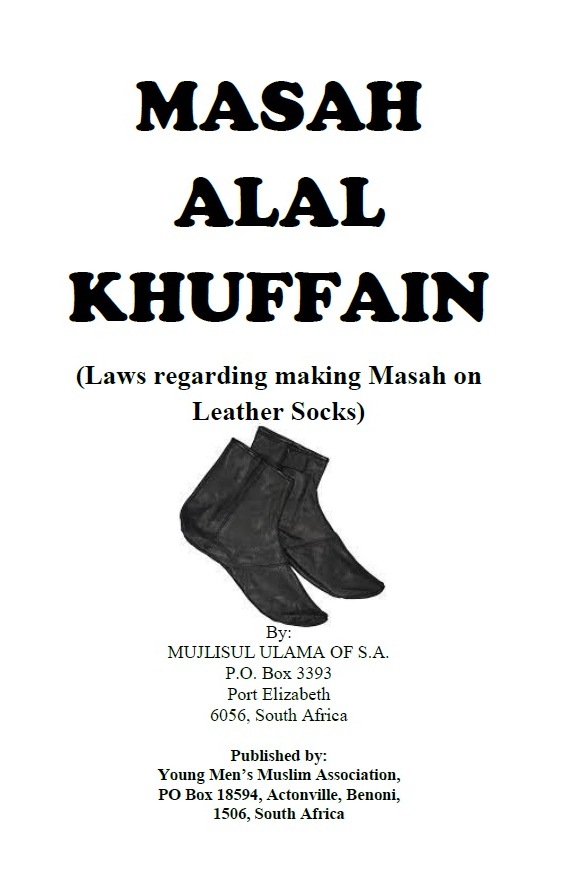
Masah means to wipe or rub. Khuffain are a special kind of socks made of leather. The act of lightly wiping the wet hand over the khuffain is called Masah.
Ghair Muqallideen (those who have renounced the Taqleed of the Four Math-habs of the Ahlus Sunnah Wal Jama’ah) among whom is the sect known as Salafis, have completely distorted the Shariah’s Ahkaam (rules) pertaining to this ibaadat. Notorious for their taqleed (blind following) of their desires, these Ghair Muqallideen have discarded the Shuroot which are necessary for the validity of Masah. They therefore claim that masah on ordinary conventional cotton, woollen and nylon socks is valid.
Purely on the basis of their personal opinion have they refuted the fourteen century old Ijmaa-ee (on which there is Consensus) Ruling of the Shariah which specifies a particular type of sock for the validity of Masah. The opinion of the Salafis is in conflict with the unanimous Ruling of the Four Math-habs —in other words, in conflict with Islam – its Shariah and the Sunnah of Rasulullah (sallallahu alayhi wasallam). Besides personal opinion, they have no Shar’i Dalaail (Proofs of the Shariah) for their baseless opinion.
The Salafis claim that they are following the Sunnah. To bolster a view, they will cite some Hadith. Their fundamental error is that they submit the Hadith to their personal opinion. But personal interpretation and opinion which conflict with the Interpretation which has been transmitted authentically down the centuries from the age of the Sahaabah and the Taabieen or from the Khairul Quroon (the Three Noblest Ages of Islam), overrides all opinions and interpretations.
Masah alal Khuffain has to be viewed in the light of the Rulings of the Fuqaha (Jurists) of the Ummah from the earliest times, not in terms of the opinions of non-entities who have popped up in this era which is so far away from the Age of Risaalat (the age of the Nabi – sallallahu alayhi wasallam), and so close in proximity to Qiyaamah.
This discussion will, Insha’Allah, set out the Proofs of the Shariah for its Law pertaining to Masah on special socks called Khuffain.
THE MEANINGS
The Meaning of Masah Alal Khuffain
According to the Shariah, Masah Alal Khuffain means to pass the wet hand over a special type of sock in which are found several conditions.
The Shuroot
The following are the necessary conditions of the special type of sock for the validity of masah:
(1) The sock must cover the entire foot including the ankles.
(2) The socks should be of such durable material that walking in them without shoes is possible for more than three miles without the socks tearing. This is the Hanafi ruling. According to the Shaafi Math-hab, the khuffain should be sufficiently durable to walk for three days and three nights. Although the Maaliki Math-hab does not stipulate walking distance, it stipulates that the material must be leather which obviously satisfies the condition of the other Math-habs. According to the Hambali Math-hab, continuous walking is not a condition. The durability of the sock is left to Urf (Popular custom). If according to the prevalent custom the sock is strong enough for walking, i.e. walking without shoes, it will be valid for masah otherwise not.
From the description of the khuffain given by the Four Math-habs, it is obvious that there is consensus on the fact that the socks are of a special type in which walking without shoes is possible without the socks tearing. The normal socks worn in this day lack in this quality.
This second shart (condition) is thus not to be found in woollen, cotton and nylon socks.
(3) The socks must be rigid enough to be able to remain intact on the leg without tying with laces/string. If the socks slides down while walking as do ordinary socks, masah thereon is not valid.
(4) The socks should be impervious, i.e. water should not be able to seep through as it would in the case of ordinary socks.
(5) The foot should not be visible through the sock.
The significance of these conditions can be better understood from the stringent condition imposed by Imaam Maalik (rahmatullah alayh). According to him, the khuffain must necessarily be of leather. Masah is not valid on khuffain of any material besides leather even if the conditions which are found in leather khuffain do exist in khuffain of other materials. This is the stringent requirement of the Maaliki Math-hab. The other three Math-habs too have their stringent requirements for the validity of masah.
MASAH
ALAL
KHUFFAIN
(Laws regarding making Masah on
Leather Socks)
By:
MUJLISUL ULAMA OF S.A.
P.O. Box 3393
Port Elizabeth
6056, South Africa
Published by:
Young Men’s Muslim Association,
PO Box 18594, Actonville, Benoni,
1506, South Africa
2
MASAH ALAL KHUFFAIN
INTRODUCTION
Masah alal Khuffain is an act of ibaadat ordered by the Shariah. Just
as all acts of ibaadat have their requisite conditions (Shuroot) for
their validity, so too does Masah alal Khuffain have Shar‘i
conditions for its validity. An ibaadat is not valid if its conditions are
not observed.
Masah means to wipe or rub. Khuffain are a special kind of socks
made of leather. The act of lightly wiping the wet hand over the
khuffain is called Masah.
Ghair Muqallideen (those who have renounced the Taqleed of the
Four Math-habs of the Ahlus Sunnah Wal Jama‘ah) among whom is
the sect known as Salafis, have completely distorted the Shariah‘s
Ahkaam (rules) pertaining to this ibaadat. Notorious for their taqleed
(blind following) of their desires, these Ghair Muqallideen have
discarded the Shuroot which are necessary for the validity of Masah.
They therefore claim that masah on ordinary conventional cotton,
woollen and nylon socks is valid.
Purely on the basis of their personal opinion have they refuted the
fourteen century old Ijmaa-ee (on which there is Consensus) Ruling
of the Shariah which specifies a particular type of sock for the
validity of Masah. The opinion of the Salafis is in conflict with the
unanimous Ruling of the Four Math-habs —in other words, in
conflict with Islam – its Shariah and the Sunnah of Rasulullah
(sallallahu alayhi wasallam). Besides personal opinion, they have no
Shar‟i Dalaail (Proofs of the Shariah) for their baseless opinion.
The Salafis claim that they are following the Sunnah. To bolster a
view, they will cite some Hadith. Their fundamental error is that they
3
submit the Hadith to their personal opinion. But personal
interpretation and opinion which conflict with the Interpretation
which has been transmitted authentically down the centuries from the
age of the Sahaabah and the Taabieen or from the Khairul Quroon
(the Three Noblest Ages of Islam), overrides all opinions and
interpretations.
Masah alal Khuffain has to be viewed in the light of the Rulings of
the Fuqaha (Jurists) of the Ummah from the earliest times, not in
terms of the opinions of non-entities who have popped up in this era
which is so far away from the Age of Risaalat (the age of the Nabi –
sallallahu alayhi wasallam), and so close in proximity to Qiyaamah.
This discussion will, Insha‘Allah, set out the Proofs of the Shariah
for its Law pertaining to Masah on special socks called Khuffain.
THE MEANINGS
The Meaning of Masah Alal Khuffain
According to the Shariah, Masah Alal Khuffain means to pass the
wet hand over a special type of sock in which are found several
conditions.
The Shuroot
The following are the necessary conditions of the special type of
sock for the validity of masah:
(1) The sock must cover the entire foot including the ankles.
(2) The socks should be of such durable material that walking in
them without shoes is possible for more than three miles
without the socks tearing. This is the Hanafi ruling.
According to the Shaafi Math-hab, the khuffain should be
sufficiently durable to walk for three days and three nights.
4
Although the Maaliki Math-hab does not stipulate walking
distance, it stipulates that the material must be leather which
obviously satisfies the condition of the other Math-habs.
According to the Hambali Math-hab, continuous walking is
not a condition. The durability of the sock is left to Urf
(Popular custom). If according to the prevalent custom the
sock is strong enough for walking, i.e. walking without shoes,
it will be valid for masah otherwise not.
From the description of the khuffain given by the Four Math-habs, it
is obvious that there is consensus on the fact that the socks are of a
special type in which walking without shoes is possible without the
socks tearing. The normal socks worn in this day lack in this quality.
This second shart (condition) is thus not to be found in woollen,
cotton and nylon socks.
(3) The socks must be rigid enough to be able to remain intact on
the leg without tying with laces/string. If the socks slides
down while walking as do ordinary socks, masah thereon is
not valid.
(4) The socks should be impervious, i.e. water should not be able
to seep through as it would in the case of ordinary socks.
(5) The foot should not be visible through the sock.
The significance of these conditions can be better understood from
the stringent condition imposed by Imaam Maalik (rahmatullah
alayh). According to him, the khuffain must necessarily be of leather.
Masah is not valid on khuffain of any material besides leather even if
the conditions which are found in leather khuffain do exist in
khuffain of other materials. This is the stringent requirement of the
Maaliki Math-hab. The other three Math-habs too have their
stringent requirements for the validity of masah.
5
The illustrious Fuqaha and Imaams of the Math-habs were Men of
Knowledge of the Khairul Quroon. Rasulullah (sallallahu alayhi
wasallam) commanding honour and obedience to them, said:
Honour my Sahaabah, for verily they are the noblest of you,
then those who come after them (the Taabieen), then those
after them (the Tab-e- Taabieen).”
It is inconceivable that these illustrious authorities of the Shariah of
the Khairul Quroon who had all unanimously based the validity of
Masah Alal Khuffain on several conditions had violated the Sunnah
in so doing. Such is the opinion of the ignoramuses of this age who
submit the Ahaadith to their whimsical desires and corrupt opinion.
The Authorities — the illustrious Aimmah-e-Mujtahideen – did not
glean their masaail (rules) from Hadith Books compiled a couple of
centuries after Rasulullah (sallallahu alayhi wasallam). They
acquired their Ilm first hand from the Sahaabah and the Students of
the Sahaabah. The ludicrous opinions of the Ghair Muqallideen of
this age in which we are, cannot override the fourteen century
Practice of the Ummah —a Practice acquired from the highest
ranking Authorities of Islam -the Sahaabah and the Aimmah-e-
Mujtahideen.
No Muslim stands in need of profound knowledge not a high grade
of intelligence to understand that any opinion or idea which develops
in this age and which is in conflict of the Laws of Islam which have
been transmitted by authentic narration from the earliest age of this
Deen, can never be part of the Shariah. The Deen was perfected in
the very age of Rasulullah (sallallahu alayhi wasallam). The Qur‘aan
and the Sunnah cannot be subjected to the interpretation of the men
of this age.
It is the height of folly for people -these Ghair Muqallideen —in this
era to cite a Hadith in substantiation of their fallacies, and to then
aver that the Aimmah and Fuqaha of the entire Ummah have erred in
6
the rulings which they had issued fourteen centuries ago. For correct
comprehension of the masaa-il of the Shariah when viewing these
laws in the light of the Ahaadith contained in the later compilations
of Hadith Kutub such as Bukhaari, Muslim, Abu Dawood, etc., it is
essential to understand that the Aimmah Mujtahideen who were the
first Students of the Sahaabah were the greatest Authorities of
Hadith, not Imaam Bukhaari, Imaam Muslim, and others
(rahmatullah alayhim). The Aimmah Fuqaha by virtue of their
investiture as Authorities of the Shariah by the Sahaabah
(radhiyallahu annum) formulated the masaa-il on the basis of the
authentic Ahaadith they acquired from the Sahaabah and the Students
of the Sahaabah. These Authorities of the Shariah did not have to
wait to be resurrected from their graves until the compilation of the
Hadith books in the third century of the Islamic era, to enable them
to systematically formulate and codify the Laws of Islam, i.e. the
Shariah, for the eternal benefit of posterity.
When the Ahkaam (Laws and Rules) of the Shariah had no need to
wait for the advent of the great Muhadditheen such as Imaam
Bukhaari and Imaam Muslim (rahmatullah alayhima), then it will
indeed be folly and insanity Islamically speaking to even suggest (as
the Salad doctrine implies) that there was a need to wait fourteen
hundred years for the likes of Al-Albaani (the Salafi Imaam of this
century) to surface on earth to rectify the ―errors of exposition‖
presented by the Students of the Sahaabah (the Aimmah). For such
ludicrous averments, there is the following Qur‘aanic response:
―When the jaahiloon address them (the
Mu‟mineen), they say: „Salaam‟.”
“We do not follow the ignoramuses.‖
THE BASIS FOR MASAH ALAL KHUFFAIN
7
The act of Masah Alal Khuffain is in conflict with rational reasoning.
The true and actual cleaner and purifier is only water, hence Tahaarat
(Purification from ceremonial impurities) is achieved only by the use
of water and not by any other liquid whatsoever. Thus, wudhu and
ghusl are not valid with any type of juice or clean (taahir) liquid.
Even if such liquid has the property of cleansing an item of its
physical impurities.
Masah is in conflict with reason because this act does not literally
clean just as sand in Tayammum is in conflict with reason because it
does not purify/clean as water does. In terms of the principles of the
Shariah, any Shar‘i Hukm which is in conflict with Qiyaas
(Analogical and rational reasoning) may not be extended to any other
act of ibaadat. It shall be confined to its Maurad (i.e. the original act
of ibaadat specified by the Shariah). An ‗irrational‘ law commanded
by the Qur‘aan or Ahaadith-e-Mutawaatarah for a particular occasion
or act may not be extended to other actions on the basis of the
Shariah‘s process of Analogical Reasoning (Qiyaas).
This will be illustrated by means of an example. Consider the
Shariah‘s mas‘alah (according to the Hanafi Math-hab) of the
breaking of Wudhu by loud laughter. If the musalli laughs aloud
during Salaat, it nullifies both his Salaat and Wudhu. The first effect,
i.e. of Salaat breaking is rational and understandable. But the second
effect, namely, breaking of Wudhu, is incomprehensible at face
value, and is in conflict with rational reasoning because when a
person laughs aloud, no impurity emerges from his body. Since only
the emergence of impurity nullifies Wudhu, the ruling of Wudhu
breaking by loud laughter is ‗illogic‘.
However, since this is the Ruling of the Shariah, we cast aside our
reasoning and our logic and submit in obedience to the command of
the Shariah because this is the Command of Allah Ta‘ala. We
confine this ruling to only Salaat. That is, loud laughter will break
8
Wudhu only if the act is committed during Salaat. Hence if someone
laughs when he is not in Salaat, such laughter will not break Wudhu.
From this it will be understood that one of the conditions for the
validity of Qiyaas-e-Shar‟i (The Analogical process of deduction of
masaail of the Shariah) is that the original basis, called Maqees
Alayh, should not be in conflict with Qiyaas.
Now consider the act of Masah Alal Khuffain. Masah on khuffain in
lieu of washing the feet commanded by the Qur‘aan is ‗illogic‘, It is
in conflict with ‗rational‘ understanding or Qiyaas. Passing a moist
hand on top of the khuffain does not, to our understanding, perform
the same function as washing the feet thoroughly with water. In fact,
the Shariah emphasises washing with water to such a degree that
even if a millimetre remains dry on any part washed in Wudhu, then
the Wudhu will not be valid. But in the case of Masah, both feet in
entirety arc left unwashed and dry. The Shariah proclaims the act of
Masah an adequate substitute for washing the feet.
Since the act of Masah Alal Khuffain came into force in total conflict
with ‗rational‘ reasoning and in conflict with Nass-e-Qat‟i, i.e. the
Qur‘aanic verse commanding washing of the feet, it will be confined
to its Maurad, i.e. KHUFFAIN. It is haraam and baatil to extend it to
any other substratum such as ordinary socks. Khuffain in the
unanimous exposition of the Authorities of the Ummah are only
leather socks.
For the unacquainted minds there is a need to further explain this
mas‘alah lest ignorance constrains people to conclude that the act of
Masah Alal Khuffain itself is unlawful in view of its conflict with the
Qur‘aanic aayat commanding washing of the feet. The highest
category of Hadith narrations is termed Ahaadith-e-Mutawaatarah.
Ahaadith of this classification are on par with Qur‘aanic verses. A
Qur‘aanic injunction can be adequately and correctly explained,
restricted and extended on the basis of such Ahaadith. There is
9
absolutely no difference of opinion among any of the authorities of
the Shariah right from the time of the Sahaabah on this issue.
The act of Masah Alal Khuffain is based on Ahaadith-e-
Mutawaatarah, hence its Mashrooiyyat (it being an order of the
Shariah). If Ahaadith-e-Mutawaatarah had not existed on the
permissibility of Masah Alal Khuffain, then it would never have been
lawful to legalize this act in lieu of washing the feet which is
commanded by the Qur‘aan.
In terms of the principles of the Shariah as explained above, it is not
permissible or valid to transfer this permissibility of Masah to any
item other than Khuffain because the original Hukm is in conflict
with Qiyaas. It has to be restricted to Khuffain which are leather
socks. It is precisely for this reason that Imaam Maalik (rahmatullah
alayh) rigidly maintains that masah is not valid on any type of socks
besides leather socks even if any other type of socks have the
qualities of leather socks. And, both Imaam Maalik and Imaam
Shaafi (rahmatullah alayhima) rule that even if Thakheen socks have
leather sewn around them, then too masah on them is not valid.
Thakheen are such heavy woollen socks which have all the attributes
of leather. They are not the normal processed and ‗refined‘ woollen
socks available nowadays in the modern world. According to the
majority of Hanafi Fuqaha, masah on Thakheen is valid because such
socks are in the very same category as Khuffain. The validity of
Masah on Thakeen is dependent on the following conditions:
•
It is possible to walk in them for more than three miles
without them tearing. The walking is without shoes on.
•
They must be non-porous preventing water seeping through.
•
They must remain firm on the foreleg without being tied
with laces, elastic, etc. They should not slip down while
walking as ordinary socks do.
10
If the socks arc of this standard, having all the properties of Khuffain
(leather socks), then according to the Ahnaaf they are in fact in the
same category as leather socks, hence it is not a question of
transferring the hukm of masah to an item which does not comply
with the Maurad (the khuffain) mentioned in the Nass (Ahaadith-e-
Mutawaatarah).
The only difference of opinion among the Shariah‘s illustrious
Authorities on this question relates to such socks which are in the
category of Khuffain. There is absolutely no difference of opinion on
the prohibition of masah on ordinary socks on which the modernist
Salafis and Ghair Muqallideen make masah to appease their nafs
(lowly desires and fancies). They have adopted the practice of masah
on ordinary socks on the basis of their weird and fallacious nafsaani
opinion, and on nothing else. They have absolutely no Hadith
support for the fallacy propagated by their imam of this century.
The Authority, Jassaas (rahmatullah alayh), in Ahkaamul Qur‟aan,
encapsulates this discussion as follows:
“The actual basis is that the purport of the Aayat (of Wudhu) is
washing which is proven (by Nass-e-Qat‟i), If it were not for the
Ahaadith-e-Mutawaatarah narrated from the Nabi (sallallahu alayhi
wasallam) regarding Masah alal Khuffain, we would not have made
lawful Masah. Since authentic Ahaadith (of the Mutawaatir class)
have been narrated we utilized it as proof for its (i.e. the masah‟s)
employment (and validity), and we used it in conformity with the
aayat in that it covers the exigency of masah (by virtue of the
Ahaadith). And, we left the balance (of the narrations which are not
Mutawaatar) on the basis of the aayat‟s command. Since the
narrations of masah on jurabain (non-leather socks have not been
narrated to the extent of the narrations of masah on khuffain, we
retained the hukm of washing on the maurad of the aayat, (i.e.
washing of the feet).”
11
JURABAIN
Jurabain are non-leather socks of wool, cotton or any other cloth.
There are some narrations which mention masah on jurabain.
However, these narrations are not of the Mutawaatar class, hence
may not be cited to override or water down a command by the
Qur‘aan. Nevertheless, an explanation for masah on jurabain
mentioned in some Ahaadith is necessary to dispel the confusion
created by the Ghair Muqallideen. Firstly, there is not a single
Authority among the Salf-e-Saaliheen (the illustrious and pious
predecessors of the Khairul Quroon era) who claims that masah on
ordinary socks is valid notwithstanding the Hadith narrations which
mention masah on Jurabain. The Authorities of those early ages had
more awareness of the meaning of jurabain in the context of masah.
Those authorities who hold the view of the validity of masah on
jurabain, do not say that masah is valid on just any type of socks such
as the socks we have in our day. According to them, if the jurabain
are covered with leather, then masah on them is valid. In this regard
it is necessary to explain in some detail for a proper understanding.
In Ahkaamul Qur‘aan, Jassaas says: ―They (the Fuqaha) differed on
the question of masal alah jurabain. According to Imaam Abu
Hanifah and Imaam Shaafi (rahmatullah alayhima) masah on
jurabain is not permissible except if they are mujallad (i.e. leather
sewn over them). Tahaawi narrates from ImaamMaalik (rahmatullah
alayh) that masah on jurabain is not valid even if they are
mujalladain (on which leather has been sewn). Some of the
Companions of Imaam Maalik narrate that according to him, masah
on jurabain is not permissible except that they be mujalladain like
khuffain. Thauri, Abu Yusuf, Muhammad and Hasan Ibn Saalih
(rahmatullah alayhim) said that if the jurabain are thakheenain, then
masah on them is valid even if they are not mujalladain.‖ (We have
already explained the meaning of Thakheen earlier.)
12
THE KINDS OF JURRAAB (NON-LEATHER
SOCKS)
There are firstly two types of jurraab or socks made of a material
other than leather, such as woollen, cotton or nylon socks. The two
kinds are called: Thakheen and Raqeeq.
Thakheen Socks
In the terminology of the Fuqaha, Thakheen are socks of such
durable and tough material which renders them khuffain for all
practical purposes. We have already explained the properties of
Thakheen earlier on.
According to Imaam Maalik‘s one view masah on jurabain is not
valid even if they are Thakheen and even if leather is sewn on them.
In another view, he avers that masah will be valid on socks of the
Thakheen kind if leather is sewn on them, for then they will in reality
bo khuffain. According to Imaam Shaafi, masah will be valid on
Thakheen socks only if leather is sewn on them. In the view of the
Hanafi and Hambali Math-habs, masah is valid on Thakheen socks
even if leather is not sewn on them, i.e. they are Mujalladain.
Raqeeq Socks
Non-leather socks in which the properties of Thakheen socks are not
found, are called Raqeeq in the terminology of the Fuqaha. Not a
single Authority of the Shariah holds the view of validity of masah
on Raqeeq socks. The only miscreants who hold this view are the
Ghair Muqallideen of this age. How can Muslims even offer any
consideration to a view which has absolutely no support in the
Shariah? From the time of the Sahaabah, it was always the mas‘alah
that masah on Raqeeq (non-!eather socks not of the Thakheen type)
was never permissible.
13
The deviate Salafis, making taqleed (blind following) of their 20th
century imam, Al-Albaani, cite the narrations of several Sahaabah
who had made masah on Jurabain. Grabbing these narrations, they
legalized masah on ordinary woollen, cotton and nylon socks Inspite
of the fact that all the Aimmah-e-Mujtahideen who were fully aware
of the Ahaadith pertaining to masah on Jurabain did not accept the
validity of masah on just any socks. All of them stipulated certain
properties to be found in the Jurabain for the masah to be valid.
These properties have already been explained earlier on in this
discussion,
The Salafis attempt to confuse ignorant and unwary Muslims on the
issue of Jurabain. They peddle the idea that ordinary socks arc the
same as the Jurabain on which the Sahaabah would make masah.
But the explanation and interpretation of Jurabain given by all
Authorities of the Shariah, and their unanimous ruling make it
abundantly clear that masah on ordinary socks is not valid since
these socks are not the kind of Jurabain on which the Sahaabah
would make masah.
MUJALLAD AND MUNA’AL
There are two kinds of Jurraab (non-leather socks): Mujallad and
Muna‘al. Socks on which the leather covers the entire foot including
the ankles are called Mujallad two are called Mujalladain), Socks on
which only the under surface (soles), heels and toes are covered with
leather are called Muna ‗al.
i) Raqeeq Mujallad are ordinary socks over which leather has
been sewn covering the entire foot. In the unanimous ruling
of the Ahnaaf (Hanafi Fuqaha), masah is valid because they
are in fact in the same category as Khuffain, According to
Imaam Maalik and Imaani Shaafi. Masah on such socks is not
valid despite the full leather outer-covering. According to the
Hanaabilah (Hambali Math-hab), it is permissible.
14
ii) Raqeeq Muna‟al are ordinary socks on which leather has be
sewn on the soles or/and the heels and toes. Masah is not
lawful on such socks in terms of all Four Math-habs.
RAQEEQ
As mentioned earlier, Raqeeq in the language of the Fuqaha refers to
all such socks which are either not covered entirely by leather or in
which the properties of Thakheen socks are not found. In this
category are our ordinary woollen, cotton and nylon socks. No Math-
hab and no Authority of the Shariah holds the view that Masah is
valid on such socks. Such socks do not come within the meaning of
Khuffain, and masah on them cannot substitute for the washing of the
feet as commanded in the aayat of Wudhu.
The severity of the ruling of prohibition on making masah on
ordinary socks can be gauged from Imaam Abu Hanifah‘s stand.
Throughout his life he held the view that masah is not valid even on
Thakheen socks although the other Hanafi Fuqaha have ruled that
masah on Thakheen socks is valid. Only during his last illness does it
appear that he had retracted this view and accepted the view of the
other Fuqaha. The question of making masah on ordinary socks
simply does not arise in the Shariah. It is unanimously prohibited.
It should now be quite clear that the issue of Masah Alal Khuffain is
not insignificant and so imple as the Salafis portray. The validity of
any ibaadat is dependent on its Shuroot (Conditions) which the
Fuqaha of the Ummat have explained in detail on the basis of the
Qur‘aan and Sunnah. Masah Alal Khuffain is no exception.
If the logic and reasoning of just any man had to be valid, then just as
the Salafis have extended the ruling of masah from Khuffain to
ordinary socks, so too may it be extended to masah on the turban
instead of the head, and masah on the niqaab (face-veil) for women
instead of the face.
15
SALAAT BEHIND A SALAFI
If the imam leading the Salaat happens to be a Salafi Ghair Muqallid
and he is wearing socks, then Salaat will not be valid behind him. It
is their common and permanent habit to make masah on ordinary
socks. Their wudhu will therefore not be valid in terms of all Four
Math-habs. Hence Salaat behind such an imam is not valid.
A BASELESS CLAIM
Another baseless claim which the modernist Salafis make is that it is
permissible to remove the socks after masah has been made on them,
and perform Salaat. This is absolutely false. Firstly, their masah is
not valid on ordinary socks. Secondly, if masah is made on proper
khuffain, these khuffain symbolically and in the law of the Shariah
acts as a preventer of the hadth (ceremonial impurity or Najaaset-e-
Hukmi) descending into the feet, hence the feet are deemed taahir
(pure) if at the time of hadth the khuffain are on. (Hadth is the state
of impurity following the nullifying of Wudhu. In other words in the
state of not being with wudhu).
If at the time when Wudhu broke, the Khuffain were not on the feet,
then the feet will have to be compulsorily washed. One may not don
the khuffain in the state of hadth, then make masah on them. The
khuffain have to be put on after a complete Wudhu. If someone
makes a complete Wudhu, then dons the khuffain, and later removes
them before his Wudhu broke, it is permissible then to perform
Salaat because the Wudhu is intact. The removal of the khuffain at
such a juncture does not nullify the Wudhu nor masah because
masah is not necessary on the khuffain which are put on after a
complete Wudhu has been made.
16
However, once the Wudhu is broken, the feet will have to be
compulsorily washed if the khuffain are removed after masah is
made on them.
THE BLIND TAQLEED OF THE SALAFIS
The followers of the deviant Salafi sect are the only people who
consider masah on ordinary socks valid. There only basis for their
fallacy is the opinion of their Imaam, Ibn Taimiyyah to whom they
offer blind allegiance. In the attempt to escape the charge of blind
following, they do not overtly cite the opinion of their Imaam.
Instead they cite the Hadith narrations which constitute the basis for
the opinion of their Imaam.
In his Fataawa, Ibn Taimiyyah states:
“Masah on jurabain is permissible when one is able to walk in them,
whether they are mujallad (covered with leather) or not is the most
authentic view of the Ulama. And, in the Sunan: Verily Nabi
(sallallahu alayhi wasallam) made masah on his jurabain and
na‟lain (shoes). And this Hadith even if it is not proven, qiyaas
(logic) demands this (validity of masah) because the difference
between jurabain and na „lain is only this that the one is from wool
and the other from leather. It is known that a difference of this nature
has no effect in the Shariah. Hence, there is no difference between
leather, cotton or woollen socks just as there is no difference
between white and black ihram. At most, leather is more durable
than wool. Thus this has no effect…” (Vol. 21 page 214)
Even Ibn Taimiyyah concedes, albeit grudgingly, that the Hadith
narration pertaining to masah on jurabain is of questionable
reliability. As such it is not valid to extend the Masah alal Khuffain
ruling (effect) to jurabain. The law pertaining to Khuffain is the
effect of Ahaadith-e- Mutawaatarah (Hadith narrations of the highest
category, the authenticity of which is absolute). It is for this reason
17
that we see that not a single one among the Aimmah-e-Mujtahideen
and the Fuqaha of the four Math-habs claiming that masah on
jurabain is valid.
While Ibn Taimiyyah has primarily resorted to logic, the authorities
of the Shariah – the Aimmah-e-Mujtahideen and the Fuqaha – have
acted purely on the Ahaadith of Rasulullah (sallallahu alayhi
wasallam) – on such Ahaadith of absolute reliability which constitute
a valid basis for omitting washing the feet inspite of this act being a
categoric command of the Qur‘aan Majeed. Since the order of masah
alal khuffain is in conflict with Qiyaas (the Shar‘i process of
Analogical Reasoning), it cannot be extended to jurabain in terms of
the principles governing valid Qiyaas and also on account of the
weakness of the relevant narrations.
It is of importance to note that Ibn Taimiyyah appeared on the scene
seven centuries after Rasulullah (sallallahu alayhi wasallam). Inspite
of the vast chasm of seven centuries between him and the age of the
Aimmah-e-Mujtahideen who had acquired their knowledge of the
Shariah from the Sahaabah, he lacked the spiritual discernment to
understand his error of differing with the Ijma ‗ (Consensus) of the
Fuqaha of the first seven centuries before him. He had failed to
understand that among these illustrious Fuqaha were all the Aimmah-
e- Mujtahideen – all those noble Fuqaha who had acquired their
knowledge from the Sahaabah. It is inconceivable that the Fuqaha of
all Four Math-habs, from the earliest time of Islam, could have
unanimously ruled in error that masah on ordinary socks is not
permissible while a man appearing seven centuries later discovered
this ‗error‘.
This position of Ibn Taimiyyah leads to the conclusion that the entire
Ummah with all its illustrious Ulama and Fuqaha from the time of
the Sahaabah had erred on this issue and for seven centuries the
Ummah was in the dark only to be extricated from this darkness by
Ibn Taimiyyah. This is most certainly untenable and unacceptable.
18
Ibn Taimiyyah‘s claim that his view is ―the most authentic of the two
(opposite) views‖ cannot be corroborated by evidence. In fact, it is
baseless. We have earlier in this discussion shown that the authorities
of all Four Math-habs – the entire Ummah – refute the validity of
masah on ordinary socks. Among these authorities the position taken
by Imaam Maalik is the strongest and most rigid. According to him
masah is valid on only leather socks while the other Fuqaha hold the
view that if socks of another material are as durable as khuffain and
have the properties of khuffain, then such socks will be in the
category of khuffain. Imaam Maalik was among the Taabieen. He
had Sahaabah for his Ustaadhs. He did not appear seven centuries
after Rasulullah (sallallahu alayhi wasallam) like Ibn Taimiyyah.
In a self-contradiction, Ibn Taimiyyah stipulates the condition of
being able to walk in the socks. This is a condition which the Four
Math-habs stipulate for the validity of masah alal khuffain. The
implication of Ibn Taimiyyah‘s condition is that masah is not valid
on such socks in which one cannot walk, i.e. walk with socks without
shoes on normal terrain. Most certainly, such walking is not possible
with ordinary woollen, cotton and nylon socks. Since ordinary socks
do not satisfy this condition, masah on them would not be
permissible even according to Ibn Taimiyyah.
It should be remembered that all the Fuqaha who lived seven
hundred years before Ibn Taimiyyah, and in particular Imaam Maalik
(rahmatullah alayh), were well aware of the existence of the jurabain
Hadith. Inspite of this, they ruled that masah on ordinary socks is not
valid.
The ruling of the Four Math-habs, viz., Masah on ordinary socks is
not valid, is the only reliable view and has existed in the Ummah
from the time of the Sahaabah.