Most Muslims are unaware of the sinister plot in which bogus UUCSA is currently involved in cahoots with the kuffaar Women’s Legal Centre and the Munaafiq MJC. The conspiracy is to have the Shariah’s ahkaam (laws) pertaining to Nikah, Talaaq, Custody, etc., abolished and to substitute in their place whatever kufr is dictated by the government in the light and ethos of the kufr constitution of the atheists.
What this Munaafiq cartel (UUCSA) is embarking on is the same old MPL and MMB kufr which the vast majority of the Muslim community had rejected with contempt. Whatever the cartel of Munaafiqeen had plotted in their MPL and MMB moves, has been regurgitated currently, albeit minus the MMB appellation. What bogus UUCSA is presently plotting to achieve with the aid of the kuffaar WLC and the kuffaar courts is nothing but old wine in a new bottle. They have discarded only the MMB designation while the demand for kufr consequences for recognition of Muslim marriages remains unchanged.
The shaitaani submission of UUCSA to the court explicitly begs for recognition of Muslim marriages along with the necessary corollary of regulating the consequences of such recognition. The consequences will be the effects of what the kufr law of the land have enacted as legislation. The ‘consequences’ do not refer to Shar’i consequences. It is explicit kufr consequences which expel the proponent thereof from the fold of Islam.
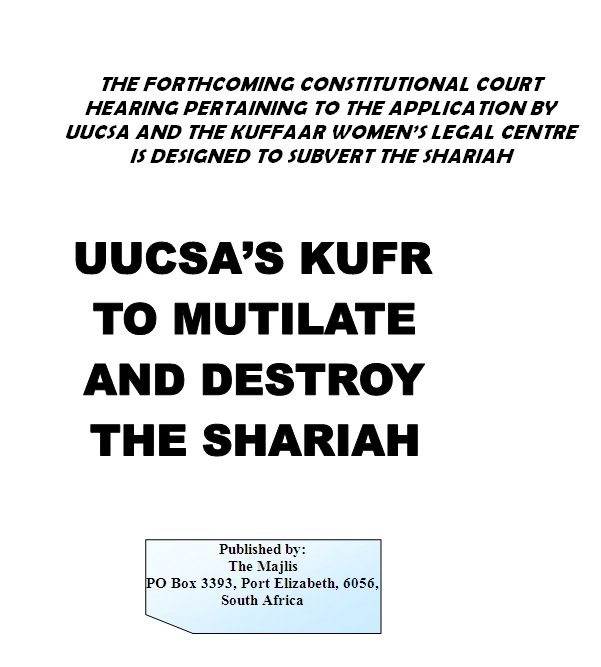
THE FORTHCOMING
CONSTITUTIONAL COURT HEARING
PERTAINING TO THE APPLICATION
BY UUCSA AND THE KUFFAAR
WOMEN’S LEGAL CENTRE IS
DESIGNED TO SUBVERT THE SHARIAH
Published by:
The Majlis
PO Box 3393, Port Elizabeth,
6056, South Africa
UUCSA’S KUFR TO DESTROY THE SHARIAH
2
INTRODUCTION
Most Muslims are unaware of the sinister plot in which
bogus UUCSA is currently involved in cahoots with the
kuffaar Women’s Legal Centre and the Munaafiq MJC.
The conspiracy is to have the Shariah’s ahkaam (laws)
pertaining to Nikah, Talaaq, Custody, etc., abolished and
to substitute in their place whatever kufr is dictated by
the government in the light and ethos of the kufr
constitution of the atheists.
What this Munaafiq cartel (UUCSA) is embarking on is
the same old MPL and MMB kufr which the vast
majority of the Muslim community had rejected with
contempt. Whatever the cartel of Munaafiqeen had
plotted in their MPL and MMB moves, has been
regurgitated
currently,
albeit
minus
the
MMB
appellation. What bogus UUCSA is presently plotting to
achieve with the aid of the kuffaar WLC and the kuffaar
courts is nothing but old wine in a new bottle. They have
discarded only the MMB designation while the demand
for kufr consequences for recognition of Muslim
marriages remains unchanged.
The shaitaani submission of UUCSA to the court
explicitly begs for recognition of Muslim marriages
along with the necessary corollary of regulating the
consequences of such recognition. The consequences
will be the effects of what the kufr law of the land have
enacted as legislation. The ‘consequences’ do not refer to
UUCSA’S KUFR TO DESTROY THE SHARIAH
3
Shar’i consequences. It is explicit kufr consequences
which expel the proponent thereof from the fold of Islam.
Lajnatun Nisaa-il Muslimaat, a Muslim Women’s body
has become one of the Respondents in the forthcoming
Constitutional Court case, and is contesting the kufr
claims and submissions of the Munaafiq UUCSA who is
concealing behind the skirts of the kuffaar female’s legal
organization.
The Lajnah is fighting the Kufr of the kuffaar WLC and
the kufr of bogus UUCSA. In the ensuing pages appear
the Lajnah’s arguments to the constitutional court.
Advocate Abu Bakr Omar of Zehir Omar Attorneys is
acting on behalf of the Lajnah.
UUCSA’S KUFR TO DESTROY THE SHARIAH
4
IN THE CONSTITUTIONAL COURT OF SOUTH AFRICA
CC CASE NO: CCT 24/21
SCA CASE NO: 612/19
CASE NO: 22481/14
In the matter between:
PRESIDENT OF THE REPUBLIC OF SOUTH AFRICA First
Appellant
MINISTER OF JUSTICE AND CONSTITUTIONAL
DEVELOPMENT Second Appellant
and
WOMEN'S LEGAL CENTRE TRUST AND OTHERS First to
Eighth Respondents
CASE NO: 4466/2013
In the matter between:
THE MINISTER OF JUSTICE AND CONSTITUTIONAL
DEVELOPMENT Appellant
And
TARRYN FARO AND OTHERS First to Eighth Respondents
CASE NO: 13877/2015
In the matter between
THE MINISTER OF JUSTICE AND CONSTITUTIONAL
DEVELOPMENT Appellant
And
UUCSA’S KUFR TO DESTROY THE SHARIAH
5
RUWAYDA ESAU AND OTHERS First to Sixth
Respondents
LAJNATUN NISAA-IL MUSLIMAAT, FIFTH RESPONDENT
IN THE WLC CASE:
WRITTEN ARGUMENTS
INTRODUCTION
1. The fons et origo of this matter was a failed application by
the applicant (“the WLC”) for direct access to the
Constitutional Court (“CC”) when Cameron JA writing for the
Court,1expressly acknowledged at Paragraph 28 that the
issues “elicited an intense response from a wide range of
organisations concerned with the position of women in the
Muslim community, the application of Islamic law and the
1Women’s Legal Centre Trust v. President of the RSA and Others
2009 (6) SA 94 (CC)
In 2009 the Women’s Legal Centre Trust (“WLC”) sought the
same/ similar relief from the CC as it did from the court of first
instance (“the court aquo”). The fifth respondent herein, Lajnatul
Nisa il-Muslimaat, applied for leave to intervene before the CC.
Although, in the unanimous judgement at para 3 the court
recorded that it did not deal with the merits of the WLC’s claims, it
did set out a brief history regarding Islamic marriages and South
African secular law: (8) In July 2003 the South African law reform
commission submitted a report entitled “Islamic marriages and
related matters (project 59)” to the Minister. The report included a
draft Muslim marriages Bill. This was produced after extensive
notice and comment process that included meetings and
workshops with various organisations representing sections of the
Muslim community.
The bill includes details of provisions recognising Muslim
Marriages as valid and regulating their consequences. However, it
proved controversial and progress on its passage appears to have
stalled.
UUCSA’S KUFR TO DESTROY THE SHARIAH
6
interest of the Muslim community as a whole” and “It is clear
from these applications that not only the legal issues, but
also the factual issues are much in dispute. They may
require the resolution of conflicting expert and other
evidence”.
2. Regarding the complexities involved, Cameron JA stated
at paragraph 29, “the ventilation of the difficult issues the
application involves in the High Court, followed possibly by a
considered judgement from the SCA, will ensure that the
views of these organisations, and the evidence that may be
germane to their contentions, will properly be considered.”
3. Six years later, and notwithstanding the aforesaid remarks
by the CC, the WLC in November 20152 sought semi urgent
relief from the court a quo. The relief sought affected every
single Muslim couple married in South Africa in terms of
Islamic rites/Shari’ah law, who wittingly or unwittingly did not
conclude a civil marriage in South Africa.
4. The fifth respondent, as an association of Muslim woman,
had a direct interest in the relief sought and successfully
applied to intervene in the proceedings before the court a
quo.
5. The fifth respondent is the only non-state party, which is a
respondent in this Appeal, which has a divergent view to the
Women’s Legal Centre Trust and its efforts for secular
regulation of Muslim/ Shari’ah marriages.
6. The order granted by the court a quo had, and the order
Supreme Court of Appeal (“SCA”) has, far reaching
consequences for every single Muslim.
2
CB Volume 1, pg1
UUCSA’S KUFR TO DESTROY THE SHARIAH
7
7. The relief was based on the facts in the WLC, Faro and
Esau cases and not on Parliamentary process or the vote of
the Muslim Community at large which had already opposed
and quashed the Muslim Marriages Bill (“MMB”).
IMPORTANT EVENTS BEFORE THE SUPREME COURT
OF APPEAL
8. The President of the Republic as the first appellant and
the Minister of Justice and Constitutional Development as
the second appellant (“the State”) appealed to the SCA with
the leave of the court a quo. Consistent with the various
affidavits filed on behalf of the State before the High Court,
the State filed comprehensive heads of argument asserting
that the appeal gave rise to 3 issues, namely:
8.1 whether in failing to prepare, initiate, introduce, enact
and bring into operation legislation recognising Muslim
marriages solemnised in accordance with Sharia law, the
President had infringed sections 9, 10 and 13 of the
Constitution;
8.2 whether there was a constitutional obligation on the state
to enact legislation recognising Muslim marriages; and
8.3 in the event a breach of constitutional obligation was
established, what the appropriate remedy was and in
particular whether the rectification ordered by the court of
first instance (the adoption of legislation) constitutes
competent and appropriate relief.
9. The State competently, persuasively, and correctly
contended in its heads of argument that the appeal before
the SCA should be determined in its favour on all three
issues.
UUCSA’S KUFR TO DESTROY THE SHARIAH
8
10. However, at the commencement of the appeal, counsel
for the State made a startling concession of sorts (“the
concession”) albeit at the invitation of the SCA, namely that
the Marriages Act 25 of 1961 (“the Marriages Act”) and
Divorce Act 70 of 1979 (“the Divorce Act”) are
unconstitutional in as far as they do not recognise Muslim
marriages. This was taken by the SCA, as seen in its
judgment3 to be dispositive of the issue.
11. Significantly there was no debate of the basis for the
request to concede, nor of the concession itself, in the face
of comprehensive and legally sound written submissions on
behalf of the State.
12. We submit that the concession was not properly made.
The State’s heads of argument properly negated the
concession.
13. Aside from lending its support from the reasons in the
High Court judgement, the SCA did not grapple with or test
those reasons against the written submissions of the State
which it is submitted rendered the concession untenable.
14. It appears, with respect, that as a result of the
concession, the SCA deemed it unnecessary to engage with
alternatively attach appropriate weight to the issues of the
doctrine of entanglement, freedom of religion and freedom of
choice, well knowing that any declaration of constitutional
invalidity would have to be confirmed by this Court, and this
Court would require and benefit from its opinion(s) on same.
3 President, RSA and Others v Women’s Legal Centre Trust and
Others 2021 (2) SA 381 (SCA) at para 15
UUCSA’S KUFR TO DESTROY THE SHARIAH
9
15. The authorities relied on by the SCA4 do not advance the
proposition that the two acts are wanting in constitutionality
for want of special mention of Shari’ah marriages. These are
cases that relate to the plight and conduct of individual
Muslim persons, respectively. They do not speak to
discrimination of nor by the Muslim community and Shari’ah
law.
16. To this extent, we submit with respect, that the SCA
erred. It remained incumbent upon it (as it does on this
Court) to fully consider the question of constitutionality,
despite the concession, and to satisfy itself on the issues
and that the concession was properly made.5
17. In regard to Muslim marriages and secular recognition,
the Department of Home Affairs conceded in its pleadings
that divided opinion could affect the unity and stability of the
Muslim community and furthermore, might create
unnecessary tension between various parts of the Muslim
community and the State at large, which the department has
sought to avoid at all costs.6
18. The State’s preference according to the affidavit filed on
behalf of the Minister of Home Affairs is for there to be large
4 Ryland v Edros 1997 (2) SA 690 (C) (1997 (1) BCLR 77; [1996]
4 All SA 557); Amod v Multilateral Vehicle Accidents Fund
(Commissioner for Gender Equality Intervening) 1999 (4) SA 1319
(SCA) ([1999] 4 All SA 421); Daniels v Campbell NO and Others
2004 (5) SA 331 (CC) (2004 (7) BCLR 735; [2004] ZACC 14)
paras 74 – 75; Khan v Khan 2005 (2) SA 272 (T).
5 Volks NO v Robinson and Others (CCT12/04) [2005] ZACC 2;
2005 (5) BCLR 446 (CC) (21 February 2005) at para 26 & 27
6 CB Volume 2, HAF 45 to the FA page 187; para 62-68
UUCSA’S KUFR TO DESTROY THE SHARIAH
10
support for any such legislation. Its reasons are that
legislation on matters concerning religion, extends very
much into the private sphere of life, it must therefore accord
with religious prescripts. The legislation, if not largely
supported, will become a very divisive measure not only
within the community but also amongst and within families
and between the community and the State at large.
19. It is against this backdrop that we submit, in seminal
matters of public importance such as the present, this Court
as the apex Court must scrutinise the concession, along with
the pleadings filed of record, and all submissions, in the face
of legal precedent and doctrine.
20. It is expected that the heads to be filed on behalf of the
State will put up the same arguments to be of assistance to
this Court, notwithstanding the concession. If the State does
not do so, or adequately do so, then the fifth respondent will
seek to place the State’s heads of argument before the SCA
before the above Court.
PROLOGUE
21. Neither Hindu nor Jewish nor Buddhist marriages are
regulated by secular law. In fact, no religion’s marriages are
specifically regulated by secular law.
22. In the President’s answering affidavit, the following is
stated: “the MMB has not been approved by cabinet and
therefore has also not been submitted to Parliament”.7 It is
against the backdrop of Cabinet’s decision not to approve
the draft bill to afford secular recognition and not force
7 CB Volume 2, Para 18, pg 161
UUCSA’S KUFR TO DESTROY THE SHARIAH
11
through legislation in the face of dissensus (a recognition by
the State not to become entangled in matters of religion and
an appreciation that neither section 7 nor section 15 of the
Constitution compelled it to do so) as well as the principal of
separation of powers, freedom of religion as a direct right
and the doctrine of entanglement that this matter must be
approached.
23. In reply to the fifth respondent’s contention that the
majority of Muslims and Muslim organizations are opposed
to the State regulation of Muslim Marriages (actual
objections to parliament were put up as annexures), the
WLC baldly denied that the Muslim public in general are
opposed. The WLC did not produce evidence to counter the
respondent’s case and evidence under oath.
24. In a constitutional democracy, should the necessary vote
not be secured in parliament, legislation to regulate Muslim
marriages should not be enacted or signed into law by the
President. The effect of the SCA’s declaratory relief ordered
emasculates the Constitution's carefully crafted scheme for
democratic governance. It ignores the institutional space
afforded to the Executive by the doctrine of separation of
powers.
25. The pleadings reveal that Government engaged the
issue for nearly two decades and owing to vociferous
objections, dissensus and complexities with religious rights,
attempts to legislate Muslim marriages were unsuccessful.8
8 Supplementary CB Volume 2, par 158-170, par 196.1, where the
WLC sets out its version of events and engagements on the
Muslim marriage issue.
UUCSA’S KUFR TO DESTROY THE SHARIAH
12
26. On the WLC’s own version, objections to the proposed
Muslim marriages bill were delivered by individuals and
organizations as far back as 20079. In its founding affidavit
at para 211, reference is made to evidence in the hands of
the Minister confirming 13 742 SMS messages objecting,
7184 petitions and 77 substantive comments from
individuals objecting.
27. Further, the WLC’s complaint at para 196.110 is that “the
process of achieving legal recognition of Muslim marriages
through the legislative has been fraught (sic)”. The process
was indeed fraught with dissensus and shut the door to any
allegation of culpability against the President, Speaker or the
other State respondents. That the Court is now expected to
act against Muslim religion is troubling.
28. In reply to the fifth respondent’s contentions about the
various organizations and objections to secular regulation in
paragraph 12 of its answering affidavit, the WLC again
baldly denied same. 11As a result, the fifth respondent re-
iterated the organizations12 per the list annexed thereto, i.e.,
who opposed the MMB secular regulation of Muslim
marriages, and who supported the fifth respondent in its
opposition.
29. It is submitted with respect that this Court ought to
accept the fifth respondent’s evidence13 and take cognizance
of the State’s efforts.
9 Supplementary CB Volume 2, par 228, pg 143.15
10 Supplementary CB Volume 2, par 196.1, pg 143.3
11 WLC Replying Affidavit to fifth Respondent’s Answering
Affidavit- para 54
12 Sixth Respondents AA deposed to by Mufti AS Dessai, para 11-
15 pg 1680
UUCSA’S KUFR TO DESTROY THE SHARIAH
13
30. The WLC’s attempt to undermine the efforts of those
against the Muslim Marriages Bill and secular regulation, by
accusing those dissenting to be in the ‘minority’, is wrong
and contrary to democratic endeavour.
31. The alleged inconsistency with Section 9 of the
constitution is not justified. The vast majority of Muslims do
not consider non-recognition of their religious marriages to
be discriminatory.
32. On the contrary, Muslims regard secular recognition to
be discriminatory against them on the basis of religion
because they are being singled out for such ‘recognition’
while the religious marriages of Jews, Hindus, etc. are
exempted from such recognition.
33. Why are Muslims being singled out for this unwanted
legal recognition which their community deems an intrusion
into their religious affairs which in turn proscribes their
freedom of religion which the constitution guarantees?
34. The Marriage act is likewise not inconsistent with section
10 as alleged.
35. The Affidavits filed on behalf of the State and fifth
respondent, as well as the annexures to the WLC’s
Founding Affidavit concerning the legislative process
regarding the MMB speak to the fact that the Muslim
community believes that its dignity and its right to have its
dignity respected and protected are in permitting them to
regulate their own marital affairs, and for the state to refrain
from imposing on Muslims unwanted ‘secular recognition’ of
their marriages.
UUCSA’S KUFR TO DESTROY THE SHARIAH
14
36. The State correctly backed off becoming entangled in
the mire of religious doctrines and tenets of Islam/Shar’iah
law.
37. Muslims regard the WLC’s attempts at regulation loathful
and characterised by singling out of Muslims and targeting
their religion, by non-Muslims or nonpracticing Muslims.
38. There is nothing in Section 28 of the Constitution which
is being violated by Muslim marriages which are not
accorded legal recognition. It is legally untenable to claim
that the Marriage Act is inconsistent with this section on the
basis of there being no legal recognition for Shari’ah
marriages.
39. The alleged inconsistency with section 34 of the
constitution is also not justified. Non-recognition of Shari’ah
marriages does not debar any Muslim from access to court.
40. Any person professing to be a Muslim who feels that his/
her dignity is adversely affected by no secular regulation is
free to resort to the secular marriage laws and to the courts.
Such Muslims are not debarred from pursuing the secular
path. There is no need for the State to enact legislation, nor
any discrimination for the recognition of Muslim marriages.
41. The simple solution for disgruntled ‘Muslims’ or for
modernist ‘Muslims’ who are averse to Shari’ah marriages or
its consequences, is to avail themselves of secular law and
‘marry’ in terms of such laws which afford them recognition.
UUCSA’S KUFR TO DESTROY THE SHARIAH
15
42. It is unjustifiable and discriminatory to subject an entire
community to measures which are loathsome and invalid in
terms of the community’s religious law.13
43. The WLC’s case centres on allegations of differentiation.
In Prinsloo v Van der Linde14 the CC held that if each and
every differentiation made in terms of the law amounted to
unequal treatment that had to be justified by means of resort
to section 33, or else constituted discrimination which had to
be sure not to be unfair, the court would be called upon to
review the justifiability and fairness of just about the whole
legislative program and almost all executive conduct. As the
court then continued, it is impossible to govern a modern
country efficiently and to harmonize the interests of all its
people for the common good without differentiation and
without classification which treats people differently and
which impact on people differently.
44. In opposition to the argument that Muslim marriages are
discriminated against as a result of non-recognition, we re-
iterate that there is no legislation recognizing any form of
religious marriage, be it Hindu, Jewish, Islamic, Buddhist or
any other religion. The approach adopted under the current
framework is to regulate only secular marriages and to afford
religious communities the freedom to conclude religious
marriages in accordance with a prescripts of their particular
religion.
13
14 Prinsloo v Van der Linde 1997 (3) SA 1012 (CC) at para 17
UUCSA’S KUFR TO DESTROY THE SHARIAH
16
45. One of the key ingredients of any person’s dignity is the
right to believe or not to believe and to act or not to act
according to his or her beliefs or not beliefs.15
46. In Fourie v Minister of Home Affairs16, in the minority
judgment by Farlam JA, the SCA affirmed that the law is
concerned only with marriage as a secular institution.
47. What ought to have put to rest the issue of the
constitutionality of the Marriages Act and the Divorce Act
with reference to non-recognition of Muslim marriages, was
the submission with reference to Minister of Home Affairs v
Fourie (Doctors for Life International, Lesbian and Gay
Equality Project v Minister of Home Affairs17 where it was
held: “in the open and democratic society contemplated by
the constitution there must be mutually respectful co-
existence between the secular and the sacred. The function
of the court is to recognize this sphere which each inhabits,
not to force the one into the sphere of the other.”
48. In the circumstances, the allegation that Muslims are
discriminated against is baseless. If anything, earmarking
Muslims and their religion for secular regulation considering
the complexities of Sharia’h law and the doctrine of
entanglement, the diverse South African and African
population, objection by Muslims and dissensus amongst
15 Christian Education South Africa v Minister of Education 2004
SA 757 at Para 36
16 Fourie v Minister of Home Affairs 2005 3 SA 429 SCA
17 Minister of Home Affairs v Fourie (Doctors for Life International,
Lesbian and Gay Equality Project v Minister of Home Affairs 2006
1 SA 524 CC
UUCSA’S KUFR TO DESTROY THE SHARIAH
17
Muslims, and the separation of powers, causes
impermissible discrimination.
49. The fifth respondent submits in response to the
allegation that there is discrimination between women in
Muslim marriages and those in secular marriages, that even
if this court holds otherwise, the discrimination is in any
event fair for reasons discussed above.
ISSUES/ SUBMISSIONS
50. The fifth respondent submits that:
50.1 the WLC do not represent the Muslim community;
50.2 one of the greatest infractions of human dignity is to
deny someone what they legitimately contracted for and
expect, who are Muslim persons in casu;
50.3 the facts relied on by the WLC pertain to the regulation
of the consequences of Muslim marriages (and Muslim
personal law) under Shariah law, spoken to in their
pleadings, in situations where secular law does not regulate
those types of circumstances;
50.4 the absence of recognition is now being used as a
platform to regulate consequences catered for by Shari’ah
law which the Marital parties contracted for by excluding
secular law;
50.5 however, the secular law and the Constitution in
particular specifically protect the right to freely practice
religion, and Islam in casu;
UUCSA’S KUFR TO DESTROY THE SHARIAH
18
50.6 in religion, and Islam in casu, Marriage is more than
contractual, it is covenantal, it is sacred, and secular law
cannot regulate it without diminishing it;
50.7 the real issue is the consequences of termination and
the WLC’s case does not focus on a lawful solution of that
issue within the context of religion, an in casu why Muslim
Marriages have been singled out;
50.8 the relief granted by the High Court, and the SCA, in
making findings regarding the recognition of Muslim
Marriages, for the sake of then regulating same within
secular law, and restricting the Shari’ah law, has no explicit
basis of support in the WLC pleadings;
50.9 constitutional attacks on the validity of legislation must
be pleaded explicitly and with specificity to enable the State
to know what case it has to meet and adduce the evidence
necessary to do so;18
50.10 apart from the fact that the WLC pleadings are
inadequate, the State heads of argument are dispositive of
the WLC case;
50.11 the MMB was the only legitimate approach and in the
case for the State, it failed constitutional muster;
18 Prince v President of the Law Society of Good Hope 2001 (2)
SA 388 (CC) para 22, as quoted by Navsa J in Minister of
Cooperative Governance and Traditional Affairs v De Beer and
Another (2021) ZASCA 95 (1 July 2021) para 95.
UUCSA’S KUFR TO DESTROY THE SHARIAH
19
50.12 the MMB is not what was brought before the Court a
quo; 50.13 the State parties incorrectly conceded as they
did;
50.14 as a result the SCA’s judgement contains broad
conclusions based on the concession;
50.15 no issue falls to be taken with the SCA finding that the
State is not under an obligation to enact legislation under the
Constitution, 19 and that paragraph 1 of the High Court Order
fell to be set aside;
50.16 the real issue is not whether the Marriage and Divorce
acts discriminate against Muslim woman. They do not
discriminate against any woman;
50.17 the issue whether these acts should have provided for
the automatic recognition of marriages concluded under
Shari’ah law was dispositively dealt with by the State.
Clearly, they could never have. They were never designed
and intended for anything other than secular regulation of
marriages of people who chose to regulate their marriages
by secular law;
50.18 the Marriages Act and the Divorce Act are not
unconstitutional in as far as they do not recognise marriages
solemnised in terms of Shari’ah law and the declaratory
relief granted in paragraphs 1.1 to 1.3 of the SCA
order ought not to have been granted;
50.19 the declaratory and interim relief ordered by the SCA,
impermissibly:
19 Concluded in paragraphs [43 and 44].
UUCSA’S KUFR TO DESTROY THE SHARIAH
20
50.19.1 has the effect of de-recognising Muslim Marriages;
50.19.2 intrudes upon the rights of Muslims to practice their
religion, Islam, freely; and
50.19.3 in fact, and in law, infringes on the doctrine of
separation of powers;
50.20 the pleadings do not even purport making out a case
that any of the marriages relied on by the WLC let alone
Muslim marriages for that matter, were/ are entered into
through coercion, or lack of consensus;
50.21 no case is made out for any of the relief granted by
the court a quo or the SCA;
50.22 the WLC pleadings before and after amendment are
characterised by a lack of specificity for the relief ultimately
prayed for or granted by the SCA;
50.23 the crux of the matter is that like all women and
married people in South Africa, Muslims have always been
free to register their marriage in accordance with secular law
or have such a marriage recognised for such consequences
where polygamy is a factor, by approaching a court; and
50.24 no case whatsoever is made out for Muslim marriages
and Muslim personal law under Shar’iah law to be changed
by order of Court.
TRANSMOGRIFICATION20
20 Oxford Dictionary of English: To transform in a surprising or
magical manner.
UUCSA’S KUFR TO DESTROY THE SHARIAH
21
51. The most profound argument against legislative
intervention into Muslim personal law in a secular
democracy is that it will inexorably lead to a
transmogrification of Shari’ah (Islamic law) and to a
contamination of its sacred sources.
52. Transmogrification and contamination take place in
fundamental ways. To mention two:
52.1 First, there is a fundamental difference in the
procedural law, including the law of evidence, between the
secular and Islamic legal systems. The present model
purports to apply Muslim personal law within a secular rather
than an Islamic procedural system. It is axiomatic that if the
law relating to the admissibility of evidence is different, as it
clearly is, the result of its application would inevitably be
different. In the article of
Asghar Ali of the Centre for Study of Society and Secularism
Mombai, he states:
“The British Government, after it seized power from
Mughals, established its own courts, which also heard cases
pertaining to Muslim marriage, divorce, inheritance etc. In
most of these courts there were either British or non-Muslim
judges who did not know Shari’ah law or if even Muslim
judges heard these cases, most of them were trained in
British laws. What these judges did was to consult Hidayah,
written by Mirghayani, a Muslim Hanafi scholar, and
translated into English by Mr. Hamilton. Often, they also
consulted some Maulavi before delivering the judgment.
Since the cases were heard in these British courts, the
procedural law followed was English law and substantive law
was based on Hidayah, it came to be known as Anglo-
Mohammedan law. The judgments in these cases delivered
UUCSA’S KUFR TO DESTROY THE SHARIAH
22
by higher courts became precedents for subsequent cases
and thus whole corpus of law came into existence based on
these judgments which came to be known as Anglo-
Mohammedan law and renamed as Muslim personal law as
calling it Anglo- Mohammedan law which was embarrassing.
Thus, to call it Shari’ah law would be a misnomer.”21
52.2 Second, as pointed out in the above quotation the idea
that non-Muslim judges could interpret Quran and Sunnah
when they do not believe in it, is foreign and impermissible in
Islamic law and will inevitably lead to contamination of
sacred principles. These judges with respect, do not know
Arabic, do not understand the text of Quran and the
sciences of Hadith (prophetic teachings) and are simply not
qualified in the principles of Islamic Jurisprudence to enable
them to do what the Bill requires. In Shari’ah a judgment is
only acceptable if the Qadi (Judge) is a Muslim, who is
knowledgeable in Quran and Hadith. There are no secular
Judges in South Africa that we are aware of, who have any
Islamic law training and even those Muslim judges, to our
knowledge, that serve in the
Judiciary, face this fundamental problem. This idea will not
find favour with most Muslims.
53. While it is recognised that some in the Muslim
community favoured the MMB it must be pointed out that the
State does not intervene in this manner in other religions
and should not so intervene in the Muslim faith. The
potential for future conflict is inevitable and foreseeable. For
example, what will happen if the court, in a case where a
21 Why Codification of Muslim personal Law? By Asghar Ali
Engineer 02 May, 2009 Secular Perspective
https://www.countercurrents.org/engineer020509.htm
UUCSA’S KUFR TO DESTROY THE SHARIAH
23
non-Muslim judge, issues a Faskh and the husband believes
that the marriage is still binding under Islamic law? Or what
happens if the court overrules the issuing of a Talaq
(divorce)? Or what will happen if under Islamic law the Talaq
is valid but under section 9(3) the court obliges the man to
maintain the women beyond the confinement (iddah) period
where the Talaq is disputed?
54. State regulation in the name of Islam which leads to un-
Islamic consequences offends the religious rights of at least
those who are opposed to secular recognition.
55. Muslims are not allowed to make unlawful that which is
lawful.
Transmogrification22 through Constitutional attack
56. The Bill of Rights in the Constitution is the supreme law
of the land. All laws must be interpreted in accordance with
the values in the Bill of Rights. It is inevitable that changes to
the substantive Islamic jurisprudence, must occur either
within the context of the initial legislation or through
subsequent attacks concerning its Constitutionality or
through subsequent secular judicial interpretation. The
resulting jurisprudence is not Islamic but secular.
57. The change to Islamic law ironically will be done under
the banner of an Act of Parliament that purports to recognise
Muslim Personal Law when in truth it seeks to change it.
22 Oxford Dictionary of English: To transform in a surprising or
magical manner.
UUCSA’S KUFR TO DESTROY THE SHARIAH
24
58. There is an inherent risk that the Shari'ah will be altered
to bring it in line with the Constitution but under the name of
Islam. This is precisely what has happened to African
customary law already. It has been ‘developed’ with secular
principles.23
59. What distinguishes African customary law from religion is
that it is custom, malleable by practice and usages over
time. It is not the inerrant and unchangeable of Gods, i.e.,
religion!
60. In the Supreme Court of India in the matter of Shayara
Bano v Union of India and others, 24 the court became
entangled in Islamic law by interpreting the Holy Quaran and
has ultimately eroded the right to freely practice Islam. It is
imperative that our constitutional democracy is protected
from what the above Court can see in the proverbial “crystal
ball” of Shayara Bano v Union of India and others and its
divisive societal consequences.
Transmogrification and contamination of Islamic law
using the Constitution
61. To take one example: under the present model a Muslim
husband has a right to exercise Talaq on broader grounds
than the wife has to obtain a Faskh (an annulment). This
may violate the right to equality and international
conventions such as the Convention on the Elimination of All
23 See: BHE and others v the Magistrate Khayelitsha and others
2005 (1) BCLR 1 (CC); Bannatyne v Bannatyne and Another 2003
(2) BCLR 111 (CC); Shilubana and others v Nwamitwa and others
2008 (9) BCLR 914 (CC)
24 Writ Petition (C) No. 118 of 2016. Copy can be provided on
request.
UUCSA’S KUFR TO DESTROY THE SHARIAH
25
Forms of Discrimination against Women. However, it allows
the spouse to freely dissolve the marriage on the same
grounds. In order to read the legislation and interpret it in
accordance with the Constitution a court would have to
broaden the grounds for a Faskh beyond levels acceptable
to Muslims who have divergent but sincerely held views.
62. Under the Shari’ah women do not have the right to
automatically issue a Talaq but men do. This too, may
violate the equality clause and it is impossible to remedy this
without giving women the exact same procedural rights to
divorce.
63. Secular interference with Islamic religion and Shari’ah
law is untenable. The doctrine of entanglement is recognised
for good reason.
DECLARATORY RELIEF GRANTED BY THE SCA
64. In upholding both the appeal and cross appeal, the SCA
declared inter alia:
“1.1 The Marriage Act 25 of 1961 (the Marriage Act) and the
Divorce Act 70 of 1979 (the Divorce Act) are declared to be
inconsistent with ss 9, 10, 28 and 34 of the Constitution of
the Republic of South Africa, 1996, in that they fail to
recognise marriages solemnised in accordance with Sharia
law (Muslim marriages) as valid marriages (which have not
been registered as civil marriages) as being valid for all
purposes in South Africa, and to regulate the consequences
of such recognition.
1.2>
UUCSA’S KUFR TO DESTROY THE SHARIAH
26
1.3 It is declared that s 7(3) of the Divorce Act is inconsistent
with ss 9, 10, and 34 of the Constitution insofar as it fails to
provide for the redistribution of assets, on the dissolution of
a Muslim marriage, when such redistribution would be just.
1.4 It is declared that s 9(1) of the Divorce Act is inconsistent
with ss 9, 10 and 34 of the Constitution insofar as it fails to
make provision for the forfeiture of the patrimonial benefits of
a Muslim marriage at the time of its dissolution in the same
or similar terms as it does in respect of other marriages.
(Own emphasis)
65. In addition, the SCA granted interim relief, as a just and
equitable remedy; that pending the coming into force of
legislation or amendments to existing legislation, that a
union, validly concluded as a marriage in terms of Sharia law
and subsisting at the date of its order, or, which has been
terminated in terms of Sharia law, but in respect of which
legal proceedings have been instituted and which
proceedings have not been finally determined as at the date
of this order, may be dissolved in accordance with the
Divorce Act as follows:
(a) all the provisions of the Divorce Act shall be applicable
save that all Muslim marriages shall be treated as if they are
out of community of property, except where there are
agreements to the contrary, and
(b) the provisions of s 7(3) of Divorce Act shall apply to such
a union regardless of when it was concluded.
(c) In the case of a husband who is a spouse in more than
one Muslim marriage, the court shall:
UUCSA’S KUFR TO DESTROY THE SHARIAH
27
(i) take into consideration all relevant factors including any
contract or agreement and must make any equitable order
that it deems just, and;
(ii) may order that any person who in the court’s opinion has
a sufficient interest in the matter be joined in the
proceedings.
66. The effect of the interim relief ordered by the SCA
pending parliament attending to the alleged
unconstitutionalities in the Marriage Act and Divorce Act, is
that the rights affirmed in Minister of Home Affairs v Fourie 25
are eroded.
67. In the interim, the mutually respectful co-existence
between the secular and the sacred has been breached.
The SCA has de-recognized the sphere which each inhabits
and forced the one into the sphere of the other.
68. We submit that what must be preserved at all costs is
the event where a couple enter into an Islamic marriage and
choose not to conclude a civil marriage or not to conclude a
contract regulating the marriage, that the consequence of
that marriage will be regulated in accordance with the
prescripts of Shari’ah.
69. The freedom to make this conscious choice is
constitutionally entrenched and must be protected. This
freedom of choice is inextricably linked to the difficult to
25 At footnote 19 above
UUCSA’S KUFR TO DESTROY THE SHARIAH
28
define term, “dignity“, as stated in Teddy Bear Clinic26 by this
Court.
70. The interim relief ordered by the SCA, is a step too far.
The doctrine of separation of powers requires the legislature
to make law and the courts to interpret and apply it to the
best of their ability.27 The interim recognition of Muslim
marriages absent any framework by the legislature amounts
to making law, a function reserved for the legislature, not the
courts.
71. Considering the complexities, even alluded to by the
SCA, for the same reasons offered by the State and
elaborated upon in the affidavits filed on behalf of the State
and fifth respondent, that militate against secular
recognition, the interim relief ordered will do untold violence
to the Constitution’s carefully crafted scheme for democratic
governance and the legislature’s carefully crafted scheme
for recognition of secular marriages. The relief ignores the
institutional space afforded to the state by the doctrine of
separation of powers.
72. It is with respect incongruous for the SCA to have
granted interim relief and accorded secular recognition to
Shari’ah marriages. It negated the consequences stemming
from Shari’ah marriages. The consequences of Shari’ah
marriages are widely at variance with the consequences of
secular and other religious marriages. It is discriminatory
and unconstitutional to accept part of the Shari’ah and to
26 Teddy Bear Clinic for Abused Children and Another v Minister
of Justice and Constitutional Development and Another (CCT
12/13) [2013] ZACC 35; 2014 (2) SA 168 (CC) (3 October 2013)
27 National Credit Regulator v Opperman 2013 2 SA 1 CC
UUCSA’S KUFR TO DESTROY THE SHARIAH
29
reject the other part, even in the interim, viz., the
consequences of Shari’ah marriages.
73. It should be well understood that a Shari’ah marriage
can never be dissolved by a court or any secular law.
Regardless of the secular law or the court’s decree of
‘divorce’, Muslims will not accept dissolution of their
marriages without Talaq or a formal Faskh (Annulment)
issued by a Council of Ulama. Thus, recognition of a
Shari’ah marriage without the requisite of Shar’iah
consequences in the event of dissolution will create
irresoluble problems. Legally, in terms of secular law, it will
be said that the marriage has been dissolved by the court’s
decree, whilst religiously, the couple will remain in wedlock
by virtue of the Nikah bond being intact.
74. This incongruous and undesirable problem will be the
consequence of State or Court entanglement in religious
tenets.
75. Neither the enactment of legislation nor the interim relief
regulating Muslim marriages will prevent scenarios such as
the cases in Daniels, Moosa N.O, Faro and Esau etc. Such
disputes will be perennial regardless of any legislation or
interim relief recognizing Muslim marriages.
76. Ultimately, the courts will have to decide the disputes. It
is therefore superfluous to have such interim relief granted
or legislation enacted.
77. Recognition/ regulation is not a panacea. The isolated
cases can and will still have to be decided by the courts.
UUCSA’S KUFR TO DESTROY THE SHARIAH
30
78. The problem is not ‘recognition’ of Muslim marriages.
The real issue pertains to the regulation of the
consequences of such recognition. If a Muslim does not
accept a court’s decree of divorce to be valid, then the
husband, if he feels that he has valid Islamic grounds, will
withhold Talaq. The woman who has a decree of divorce
from a court will thus still be in his Nikah. The woman’s
rejection of the Shari’ah law applicable to her case will
render her an apostate in Islam.
79. Just as secular recognition and regulation would, the
interim relief will open up a pandora’s box of problems and
injustices for the Muslim community. This will be the
consequence of the State and Court’s interference in
religious matters. It will be tantamount to denial of Muslim
religious freedom which the Constitution affords.
80. The separation of powers issue, as well as the doctrine
of entanglement lie at the core of the relief granted by the
High Court and the SCA. We submit so for the following
reasons inter alia:
80.1 it cannot be gainsaid that the state faced serious
opposition by Muslims to the promulgation of legislation
recognizing Muslim marriages. Accepting that the legislature
abandoned the exercise in respect of the Muslim Marriages
Bill for this legitimate reason, it was clearly then improper for
the SCA to simply forge ahead and recognize Muslim
marriages for the purposes of interim relief in circumstances,
where legitimate legislative process was employed,
recognition was opposed, and such process legitimately
abandoned;
UUCSA’S KUFR TO DESTROY THE SHARIAH
31
80.2 it is inconceivable that the courts can make law that the
legislature, through the ordinary operation of its machinery,
did not;
80.3 the doctrine of entanglement applies as much to the
courts as it does to the legislature attempting to regulate
Muslim marriages; and
80.4 the interim relief has the same effect, although for a
shorter period, as a legislative choice. In My Vote Counts
cited above, this court held that it is for parliament to make
legislative choices as long as they are rational and otherwise
constitutionally compliant. With respect, the SCA, in the
interim relief granted, impermissibly trenched on
parliament’s terrain.
81. Recognition of Muslim marriages in the secular realm
amounts to derecognition of Muslim marriages, which
originate in the Shari’ah. The effect of the order permitting
divorce in Islamic marriages under the Divorce Act in the
interim, is to replace and substitute Talaq (divorce) regulated
by the Holy Quran and Shari’ah.
82. There are fewer clearer examples of entanglement in
doctrinal issues, transmogrification, and erosion of the right
to freely practice one’s religion than the one in casu. The
effect of the interim relief permitting divorce in Islamic
marriages under the Divorce Act, is to replace and substitute
Talaq (divorce) regulated by the Holy Quran and Shari’ah.
83. The concepts of Talaq and Faskh will be replaced with
proceedings for a divorce under the Divorce Act. This
undoubtedly creates far reaching inroads into the principles
of Shari’ah in that a divorce may only be granted by a court
UUCSA’S KUFR TO DESTROY THE SHARIAH
32
on either one of the two grounds identified in section 3.
Since the scheme of the Divorce Act is clearly premised on a
monogamous marriage, it is anomalous to subject Muslim
marriages, in the interim, which are polygamous, to the
Divorce Act, as polygamous marriages are manifestly
inconsistent with it. A simple example is that section 4 (2) of
the Divorce Act identifies as a factor that is indicative of an
irretrievable breakdown in a marriage, where the “defendant
has committed adultery and that the plaintiff finds it
irreconcilable with a continued marriage relationship”.
84. By recognizing Muslim marriages under the Marriage Act
and the Divorce Act in the interim, the proprietary
consequences in section 7 (3) of the Divorce Act, will apply
to Muslim marriages. This again will substitute the present
position in terms where all the propriety consequences of a
marriage concluded under Shar’iah will on divorce, be
regulated by Shar’iah. This amounts to an infringement of
religious rights and freedoms of all Muslims in South Africa
(whether they agree with recognition or not), in the interim,
and without justification.
85. The interim relief by the SCA is problematic in that it has
the effect of wholesale recognition of marriages concluded
under Shar’iah. In other words, because it will apply to every
marriage which is in existence when the order became
operative, which marriages were purportedly concluded no
matter how long and the circumstances thereof, even if there
is no documentary proof and the Imam is no longer available
to attest to the marriage.
UUCSA’S KUFR TO DESTROY THE SHARIAH
33
86. In ITAC v SCAW SA28 it was held: “when a court is
invited to intrude into the terrain of the executive, especially
when the executive decision-making process is incomplete,
it must do so only in the clearest of cases and only when
irreparable harm is likely to ensue if the interdictory relief is
not granted.
87. In National Treasury and Others v Opposition to Urban
Tolling Alliance 29 at para 84, Justice Froneman pointed out
that the court found that the interdict improperly breached
the separation of powers in intruding upon the formulation
and implementation of international trade policy, a matter
that resides in the heartland of national executive function.
CONCLUSION AND COSTS
88. In the event that the above Court upholds the findings of
constitutional invalidity, then we submit that a just and
equitable remedy be carved out only in the Esau and Faro
matters.
89. There is no case made out for immediate interim relief
that affects thousands of Muslims not represented in these
proceedings, especially where the legislature has faced
clamouring opposition to previous attempts to regulate
Muslim marriages and will face same again. The application
to individuals not before court should be restricted so as not
to interfere in the private lives and religious rights of those
who do not support secular recognition but who in fact
28 ITAC v SCAW SA 2010 ZACC (6) 2012 4 SA 618 CC
29 National Treasury and Others v Opposition to Urban Tolling
Alliance and Others (CCT 38/12) [2012] ZACC 18; 2012 (6) SA
223 (CC)
UUCSA’S KUFR TO DESTROY THE SHARIAH
34
oppose it. Muslim persons affected by this approach still
have access to courts.
90. Should this court decide to uphold the SCA’s reasoning,
the proposed enactment should not be a draconian measure
bringing the entire Muslim community within its purview.
Muslims who are averse to recognition must be given the
right to opt out and to submit themselves to the Shari’ah.
Such voluntary submission to the Shari’ah is not detrimental
to others. It is a purely personal choice applicable to persons
who make the choice of their own free will.
91. There is no valid reason for arbitrarily imposing
recognition since such recognition will be a denial of a host
of Shari’ah tenets which Muslims religiously and fervently
submit to, and which they believe are necessary for their
eternal salvation in the Life After.
92. It is submitted that it is irreconcilable with the right to
freedom of religion and to the freedom to practice Islam, to
subvert Muslim marriages to the secular law. Regulation
presents endless, foreseeable constitutional problems.
93. The fifth respondent submits that the order of the court a
quo ought to be set aside and each party be ordered to pay
their own costs.
Reg Willis
Abu Bakr Omar
Fifth Respondent’s Counsel
Chambers
Sandton
8 July 202
UUCSA’S KUFR TO DESTROY THE SHARIAH
35
LIST OF AUTHORITIES
LEGISLATION
1. The Divorce Act 70 of 1979
2. The Marriage Act 25 of 1961
SOUTH AFRICAN CASES
1. Women’s Legal Centre Trust v. President of the RSA and
Others 2009 (6) SA 94 (CC)
2. President, RSA and Others v Women’s Legal Centre
Trust and Others 2021 (2) SA 381 (SCA)
3. Ryland v Edros 1997 (2) SA 690 (C) (1997 (1) BCLR 77;
[1996] 4 All SA 557
4. Amod v Multilateral Vehicle Accidents Fund
(Commissioner for Gender Equality Intervening) 1999 (4) SA
1319 (SCA) ([1999] 4 All SA 421)
5. Daniels v Campbell NO and Others 2004 (5) SA 331 (CC)
(2004 (7) BCLR 735; [2004] ZACC 14)
6. Khan v Khan 2005 (2) SA 272 (T)
7. Volks NO v Robinson and Others (CCT12/04) [2005]
ZACC 2; 2005 (5) BCLR 446 (CC) (21 February 2005)
8. Prinsloo v Van der Linde 1997 (3) SA 1012 (CC)
9. Christian Education South Africa v Minister of Education
2004 SA 757
10. Fourie v Minister of Home Affairs 2005 3 SA 429 SCA
11. Minister of Home Affairs v Fourie (Doctors for Life
International, Lesbian and Gay Equality Project v Minister of
Home Affairs 2006 1 SA 524 CC
12. Prince v President of the Law Society of Good Hope
2001 (2) SA 388 (CC)
13. BHE and others v the Magistrate Khayelitsha and others
2005 (1) BCLR 1 (CC)
14. Bannatyne v Bannatyne and Another 2003 (2) BCLR 111
(CC)
UUCSA’S KUFR TO DESTROY THE SHARIAH
36
15. Shilubana and others v Nwamitwa and others 2008 (9)
BCLR 914 (CC)
16. Teddy Bear Clinic for Abused Children and Another v
Minister of Justice and Constitutional Development and
Another (CCT 12/13) [2013] ZACC 35; 2014 (2) SA 168
(CC)
17. National Credit Regulator v Opperman 2013 2 SA 1 CC
18. ITAC v SCAW SA 2010 ZACC (6) 2012 4 SA 618 CC
19. National Treasury and Others v Opposition to Urban
Tolling Alliance and Others (CCT 38/12) [2012] ZACC 18;
2012 (6) SA 223 (CC)
FOREIGN CASE
1. Shayara Bano v Union of India and others (C) No. 118 of
2016
ACADEMIC ARTICLES
1. Why Codification of Muslim personal Law? By Asghar Ali
Engineer 02 May,
2009 Secular Perspective
https://www.countercurrents.org/engineer020509.htm
0:00--:--
Reproduced from https://themajlis.co.za/books/uucsas-kufr-to-mutilate-and-destroy-the-shariah/